Summer is often seen as a quieter season for marketing and sales teams. But it’s actually the perfect time to get ahead of the September ramp-up.
With fewer day-to-day demands and more time for strategic work, summer offers the ideal opportunity to review your content, optimize your marketing materials, and prepare more effective campaigns for the months ahead.
Audit your existing content
Before creating new content, take a close look at what you already have.
Ask yourself:
Is this content still accurate and up to date?
Does it reflect our current positioning and messaging?
Which materials are used most often by our sales teams?
Which documents are rarely—or never—used?
A content audit often uncovers the same issue: most of the resources you need already exist, but they’re underused, outdated, or difficult to find.
Update your key marketing materials
Once your audit is complete, focus on refreshing your most important assets, such as:
Sales brochures
Product presentations
White papers
Solution sheets
Customer case studies
The goal isn’t to recreate everything from scratch. Instead, make sure your core content is accurate, consistent, and aligned with your September marketing objectives.
Organize your content on Calaméo
After reviewing your content, it’s time to start with a clean, well-structured library.
On Calaméo, this means taking the time to organize your publications by:
Removing or archiving outdated publications
Updating documents that are still relevant
Consolidating different versions to eliminate duplicates and older editions
Reviewing titles, descriptions, and categories for consistency
Highlighting your most important publications
A well-organized publication library does more than look professional. It helps your teams quickly find the right content and makes it easier for customers and prospects to access your most valuable resources.
Prepare your september campaigns in advance
Summer is also the ideal time to start planning your September campaigns.
This includes:
Selecting the content you’ll promote
Creating reading paths or presentation journeys
Organizing content by business objective, such as lead generation, customer retention, or product launches
Preparing resources for your sales teams
When September arrives, having your content already organized and ready to use allows your team to respond faster and deliver greater impact.
Conclusion
Preparing your September marketing strategy during the summer isn’t about creating more work — it’s about making better use of what you already have.
By auditing, updating, and organizing your content in Calaméo, you can turn a quieter season into a valuable opportunity to improve efficiency, strengthen collaboration, and set your marketing and sales teams up for a successful final quarter of the year.
Summer is drawing to a close, and September is just around the corner. After a few weeks away, projects will soon be picking up again, editorial calendars will start filling up, and the final deadlines of the year will quickly come into view.
Now is the perfect time to look ahead and ask yourself a simple question: what content can you still create and share before the end of the year?
From essential publications to more creative formats, here are 5 content ideas to add to your editorial calendar now.
1. A magazine to share your latest updates
The back-to-school season often brings plenty of news and new projects. It’s a great opportunity to bring your latest updates, initiatives, and highlights together in a digital magazine.
Company news, interviews, upcoming events, profiles, tips, or customer stories: a magazine gives you the opportunity to tell your story in a more engaging, editorial format and create a regular touchpoint with your audience.
And why not make your next issue more interactive? Links, videos, and additional content can turn a digital publication into much more than a simple document to read.
2. A catalog to prepare for the final months of the year
For businesses offering products or services, the final months of the year are often a key period.
New products, seasonal collections, special offers, or curated selections: a digital catalog makes it easy to showcase your offering while providing a smooth and engaging reading experience.
One piece of content, countless ways to put it in front of your audience.
3. A guide or white paper to showcase your expertise
The approaching back-to-school season is also a great time to share your expertise and start meaningful conversations around your industry.
Why not turn your knowledge into a practical guide, white paper, or in-depth report? This type of content can answer your audience’s questions while strengthening your position as an expert in your field.
Some ideas include a guide to preparing for the year ahead, a report on industry trends, a market analysis, or a collection of practical tips.
Useful content is content people want to keep, share… and come back to later.
4. A report or review to tell the story of your year
As the end of the year gets closer, it’s also time to start thinking about looking back. What projects have you completed? What results have you achieved? And which moments have defined the past year?
Annual reports, activity reports, sustainability reports, or year-in-review publications can all become valuable communication tools.
Rather than simply presenting a collection of figures and information, think about telling a story: what did you achieve this year, and where do you want to go next?
A digital publication can help you structure this information and make it easier and more enjoyable to explore.
5. A year-in-review to end the year on a high note
Why not end the year with a more editorial approach?
A year-in-review is a great way to revisit the highlights of the past twelve months while showcasing the people, projects, events, or publications that made an impact.
It’s an opportunity to create content that feels both informative and personal. You can include key figures, major achievements, highlights from your year, or even your most popular content.
Most importantly, it’s a great way to connect the year that is ending with the one that is about to begin.
Time to plan your editorial calendar!
There are still a few months left before the year comes to an end. That means there’s no need to wait until December to start thinking about your upcoming content.
Magazines, catalogs, guides, reports, or year-in-review publications: each format can serve a different purpose while helping you showcase your expertise and stay connected with your audience.
Before filling up your editorial calendar, take a few minutes to identify the content that will bring the most value to your readers.
What if your next publication was already the first step toward your year-end communications?
Have you ever seen an advertisement and immediately known which company it belonged to, even if you didn’t glimpse the name? Chances are you recognized certain facets of that company: special fonts, taglines, logos, and color combinations that belong unmistakably to a brand. These elements, and more, make up a brand’s identity. All visual and editorial aspects of a brand’s identity are determined by the brand’s style guide.
On the Calaméo blog we have talked about logos, brand identity and brand image. Next up? Brand style guides, sometimes called graphic charters or brand guidelines. In this article we will discuss the ins and outs of this important document, so let’s dive in!
First thing’s first: what is a brand style guide? A brand style guide is a document that governs all the visual (and sometimes editorial) elements of a company that make it recognizable and unique. It also explains when and how to use these elements. Simply put, a style guide is the key to all communications!
These guides ensure that there is no confusion when it comes to what the brand’s content should look and sound like. Using the guide as a reference, all company communications are consistent across channels and mediums. The style guide can be as detailed as you like; typically, larger companies have more comprehensive style guides because they are more likely to use a wider range of communication channels, and they appear in more places (television, print, online, etc.).
Who creates the style guide?
The creation of brand style guides is best left to professionals. However, it’s a collaborative process: graphic designers or design firms will work with you to create a style guide that suits your company and fits your brand identity. You must decide who you are, your values, and the image you’d like to portray to the world.
Why and how should you use a style guide?
A brand style guide is essential for your company’s brand identity. In order to maintain clear and cohesive communications across all channels, a style guide is the ultimate reference. Internal documents such as slide decks and employee newsletters, external communications such as advertisements or social media posts, plus everything in between: all of this content must look similar and adhere to your brand identity. To achieve this consistency, companies must have a brand style guide. Otherwise, logos may appear in the wrong colors and dimensions, there won’t be a uniform look to your communications, and your tone will be all over the place. Any communication that comes from the company, both internally and externally, should use the style guide as a reference.
What is included in a style guide?
Length and details may vary depending on the company, but a brand style guide is usually made up of the following visual and editorial elements:
Logo
Logos are a crucial part of a brand’s identity, its most visible identifier. Logos are images, texts, or shapes (or a combination of the three) in the company’s color palette that represent the company. A blue bird invokes Twitter, three stripes on a sneaker will certainly mean that they are Adidas, and a swoosh (both the shape and the word) is emblematic of Nike.
A company’s logo cannot be used haphazardly. The brand style guide should explicitly outline the exact colors and dimensions of the logo. Even the background on which the logo appears is specified in the style guide.
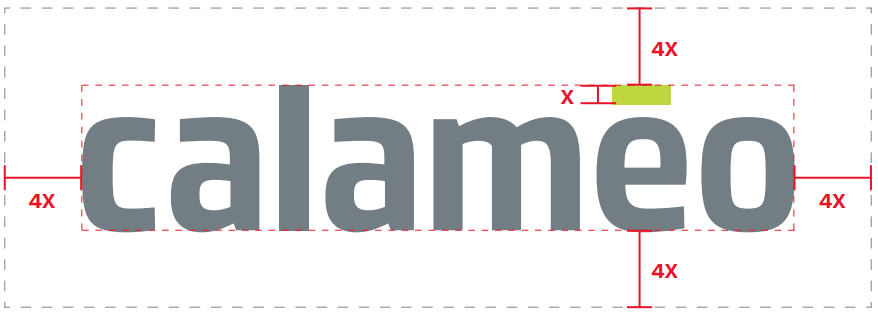
Take Calaméo’s logo, for example. The spacing and colors are exact: the dimensions around the lettering are determined by the height of the green accent, and the colors are specific to our brand.
There are other elements to consider. Do you have a slogan or motto with words as part of your logo? If so, you must clearly state where the slogan goes, how big it can be, the color(s) to use, and when to employ this version of the logo. There are many rules you must define in your brand style guide, especially when it comes to your logo.
Colors
Companies have specific brand colors, usually two to three, that they use in logos and branding. The style guide will include complementary colors as well. These colors all together are known as the company’s color palette.
Great thought and care go into a company’s color palette. There are even psychological tricks behind choosing certain colors that the company wants associated with the brand or product. They may want to demonstrate trust, youth, sophistication, or other descriptors.
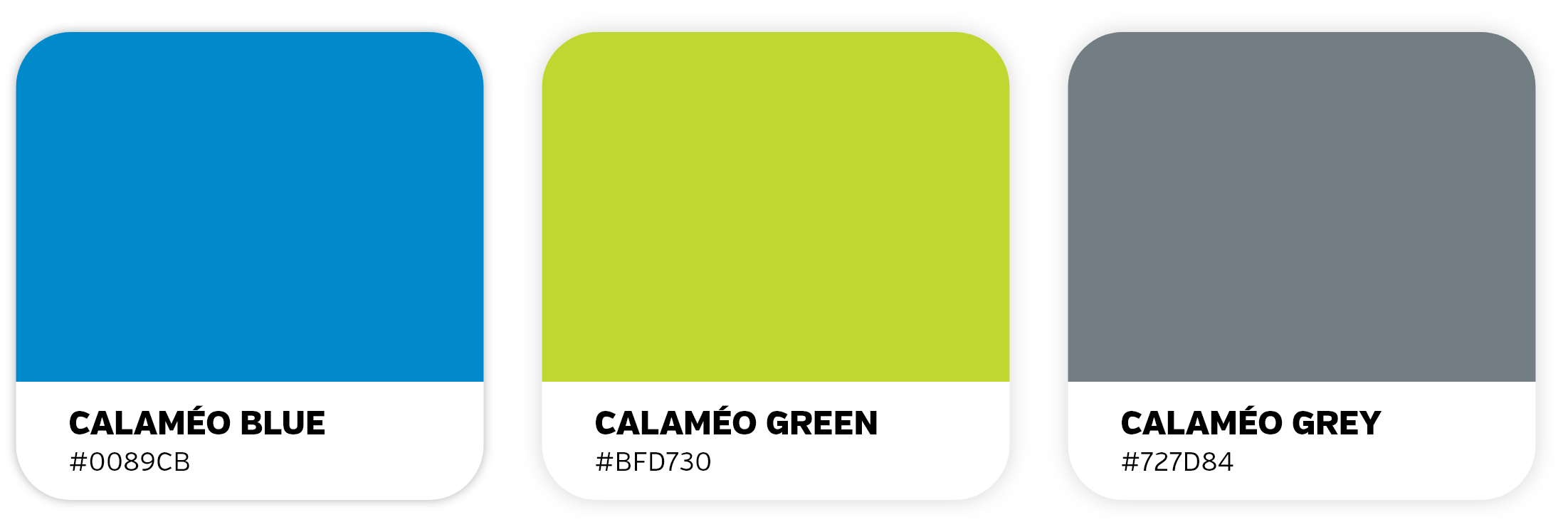
The brand style guide should outline all the ways to find these colors: a visual representation of the color, HEX and RGB formats, and other formats if necessary. Rather than just “blue” or “red”, companies choose very specific shades of these colors that go well together and set them apart from other brands. These exact shades need to be used every time.
Examples of Calaméo’s color palette using the HEX values
Typeface
Another important element of the brand style guide is typeface. Typeface is the kind of lettering used in communications, which includes fonts. Does your company use only lowercase letters? All capitals? You must include the size, spacing, and color of your typeface in your style guide so employees know exactly how the typeface should look.
Work with a graphic designer to choose the best typeface for your company. Some brands even create their own fonts! Keep in mind that your typeface also reflects your tone– is it silly, serious, elevated? Your typeface must work well with the other elements of your style guide.
Images
Some brand style guidelines include rules about styles of images or photographs to use. These images must fit into the brand’s identity and remain consistent; you should not use a bright and airy photograph one day and then a dark and moody photograph the next. The rules could include using colors from the company’s color palette or desired emotions that the images should evoke (energetic, powerful, soothing). Images are available to download on sites like Getty Images, Shutterstock, or Unsplash, if your company does not have access to a photographer or photography studio to create your own images. However, make sure to check that you have the right to use the images.
Icons
Brand style guides may also include illustrations or icons. Consider the icons you see on a company’s website: a shopping cart to click on when you are ready to purchase or an envelope icon if you want to communicate with the company via email. These icons must be coherent across all platforms. Icons will, much like the rest of the elements of the style guide, reflect the brand identity. Whimsical, rigid, colorful, playful…your icons can express a lot about your brand!
A few of Calaméo’s icons
Tone
Your tone and voice give your brand a personality via the written word. Once you decide who you are, it should be easy to find your company’s tone The brand style guide may include different instructions depending on the channel– perhaps your social media tone will be slightly less formal than that of your advertisements, for example. The guide should include written examples so employees can see how to employ the tone in different situations. Think of the image you want to project, and stay consistent.
Applying your style guide to digital publications
So now that you know all about style guides, it’s time to apply this knowledge to your digital publications! Because digital publishing is a visual medium, consistent brand visuals make all the difference between an amateur-looking document and a professional-grade publication.
With Calaméo, you can personalize your viewer Theme, add your logo, and enrich your content yourself so that your digital publications match your brand identity. With our White Label feature for PLATINUM members, your publications appear in your name and image, without the Calaméo logo. Start your free trial today!