In 2026, digital marketing continues to evolve, but one thing remains clear: long-form content is an essential tool for brands that want to stand out, build a loyal audience, and make a real impact. While short formats continue to capture attention, long-form content allows you to dive deeper into topics, demonstrate your expertise, and provide a rich experience for your audience.
With tools like Calaméo, creating and sharing interactive long-form content has never been easier, more effective, or visually appealing.
Why long-form content remains strategic
Creating long-form content may seem challenging, but it offers tangible benefits for your marketing strategy:
Boost credibility and expertise A detailed article, comprehensive guide, or ebook demonstrates your mastery of a topic and builds trust with your readers.
Improve SEO performance Search engines reward rich, relevant content. The more your content addresses user needs, the higher it ranks in search results.
Deeply engage your audience Readers who spend more time with your content are more likely to subscribe, share, or convert into customers.
Repurpose content across multiple formats A long article can be turned into infographics, social media carousels, or even videos—maximizing your reach across channels.
Long-form content formats to prioritize in 2026
Long-form content isn’t limited to traditional blog posts. In 2026, innovative brands leverage different formats to captivate their audience:
Ebooks and comprehensive guides – perfect for generating qualified leads.
Industry reports and studies – enhance credibility and encourage sharing.
Enhanced newsletters – go beyond the standard email by providing detailed analyses or interviews.
Interactive publications on Calaméo – embed videos, polls, forms, and clickable links to make long-form content more dynamic and engaging.
With Calaméo, you can create interactive publications that go far beyond simple text. Your readers enjoy an immersive experience, whether on desktop or mobile, while strengthening your brand image.
How to produce effective long-form content
To make your long-form content truly impactful, it should be structured, engaging, and easy to consume. Here are some best practices:
A clear, compelling headline – communicate the value of your content upfront.
A captivating introduction – grab attention within the first few lines.
Subheadings and short paragraphs – improve readability and comprehension.
Bullet points and visuals – summarize information and break up the text.
Interactive media – videos, clickable links, polls, or forms enhance the user experience.
Relevant calls to action – guide readers toward the next step (download, sign up, share).
With Calaméo, you can combine all of these elements in a single publication. Readers can explore, interact, and return to your content anytime.
Conclusion: why invest in long-form content in 2026
Long-form content isn’t just a trend—it’s a strategic investment for your brand. The benefits include:
Positioning yourself as an expert in your field.
Increasing engagement time and boosting conversions.
Improving SEO and long-term visibility.
Offering an interactive, immersive experience through modern tools like Calaméo.
In short, creating long-form content in 2026 combines expertise, visibility, and engagement, while providing a truly enriching experience for your audience.
With Calaméo, you have the ideal tool to design interactive publications that captivate readers and bring your long-form content to life.
If there’s one thing you need to know about ecommerce in 2020, it’s the number 4.206. Trillion. $4.206 trillion is the total volume of retail sales projected to take place online next year worldwide. That’s nearly double since just 2017 and just three years from now, ecommerce will represent one-fifth of the global retail market.
In other words, online sales are huge—and only getting more important for modern business. But the explosion of ecommerce has led to big changes in the ways that customers and companies interact. Not limited to the aisles of a store, shoppers invest significant time in learning about brands and products online before making a purchase. Connecting with customers now means standing out among the infinite options available on the internet.
Sound like a challenge? Luckily, a smart approach to online sales can bring great opportunities for your business to grow. Keep reading for three essential ecommerce trends to watch as well as our look at the best ways to adapt in 2022 and beyond.
Shopping without borders
Thanks to the internet, people all over the world are able to connect. 67% of the global population is now online and users everywhere log on to chat, share and shop. It’s easier than ever for today’s customers to discover products from faraway places and order in just a few clicks.
More important, they don’t hesitate to buy internationally. According to Shopify, 57% of online shoppers make purchases from overseas sellers. An ecommerce presence can allow businesses to access a new, global base of potential customers. But first you’ll need to analyze your audience. If you have a digital catalog, for example, who is already browsing it? Do your international visitors signal interest in your products by clicking Shopping links? Are there sales to match or is there a disconnect between your overseas audience and your customers?
The answers to these questions will help you determine where to start optimizing your ecommerce activity for international buyers. This might be as simple as providing sales and marketing content in a polished translation. Or it could involve adjusting the payment and delivery options that you offer. No matter what you do to develop global sales, don’t overlook the B2B category. Worldwide B2B online revenue has reached $10.6 trillion, compared to just $2.8 trillion for the B2C market.
Hybrid customer journeys
Although ecommerce has been growing fast, there is strong evidence that it is most effective when combined with other channels. For example, Google has found that 61% of shoppers prefer to buy from brands that have an offline retail outlet in addition to an online store. Even more mix online and offline to shop: over 80% cross between digital and physical channels as they research and purchase products. B2B research includes an online search 90% of the time and outreach often happens only once the buyer’s decision-making process is halfway finished.
Since customers who interact with a company in these different ways also spend more, maximizing your business’s assets for online and offline use is key. The online discoverability of your products should be a priority, but traditional marketing material still has serious value. While 35% of online product searches begin with Google, 82% of all shoppers have started a purchase with a catalog.
In fact, catalogs rank alongside store visits and browsing online as favorite way for people of all ages to interact with brands. Digitizing your catalog allows you to make this offline channel searchable and shoppable online. By being a part of both experiences, your catalog can meet the needs of today’s customers and become a point where ecommerce and traditional shopping intersect.
The experience factor
As shoppers spend more time deciding what to purchase, businesses are increasingly attentive to the complete customer experience. Instead of beginning when a potential buyer walks into your store, that experience now might start online with your company’s name appearing in search results. It can span online and offline research, orders and service, touching everything from reading your blog to navigating a product exchange.
Because there are so many different elements to take into account, customer experience can be difficult to manage. One area that brands are focusing improvements on is the creating a consistent experience for customers, digitally and in stores. Over half of retailers worldwide called it their top priority in 2019. The stakes are high: up to 75% of US shoppers say that customer experience matters to them when considering a purchase.
To make the most out of ecommerce, look for innovative ways to connect the online and offline experience. You can start small with a simple step, like adding your company branding to digital assets, or think bigger by optimizing how customers shop your site. There are dozens of UX changes you can test to produce a better experience for your clients—and hopefully boost your sales, too.
Add to basket
All three of these trends are well worth incorporating into your business’s digital sales strategy for 2020. Taking advantage of international shoppers, customers’ varied paths to purchase and the customer experience opportunity can help you move forward in market that is still developing fast. Trends that will shape the future of ecommerce are already starting to emerge, like omnichannel personalizationand frictionless payment. Embrace the challenge of modern ecommerce and get ready to shop for the next big thing.
Read this article in our 4th issue of Calaméo Magazine, as well as many others on the theme of shopping:
Have you ever seen an advertisement and immediately known which company it belonged to, even if you didn’t glimpse the name? Chances are you recognized certain facets of that company: special fonts, taglines, logos, and color combinations that belong unmistakably to a brand. These elements, and more, make up a brand’s identity. All visual and editorial aspects of a brand’s identity are determined by the brand’s style guide.
On the Calaméo blog we have talked about logos, brand identity and brand image. Next up? Brand style guides, sometimes called graphic charters or brand guidelines. In this article we will discuss the ins and outs of this important document, so let’s dive in!
First thing’s first: what is a brand style guide? A brand style guide is a document that governs all the visual (and sometimes editorial) elements of a company that make it recognizable and unique. It also explains when and how to use these elements. Simply put, a style guide is the key to all communications!
These guides ensure that there is no confusion when it comes to what the brand’s content should look and sound like. Using the guide as a reference, all company communications are consistent across channels and mediums. The style guide can be as detailed as you like; typically, larger companies have more comprehensive style guides because they are more likely to use a wider range of communication channels, and they appear in more places (television, print, online, etc.).
Who creates the style guide?
The creation of brand style guides is best left to professionals. However, it’s a collaborative process: graphic designers or design firms will work with you to create a style guide that suits your company and fits your brand identity. You must decide who you are, your values, and the image you’d like to portray to the world.
Why and how should you use a style guide?
A brand style guide is essential for your company’s brand identity. In order to maintain clear and cohesive communications across all channels, a style guide is the ultimate reference. Internal documents such as slide decks and employee newsletters, external communications such as advertisements or social media posts, plus everything in between: all of this content must look similar and adhere to your brand identity. To achieve this consistency, companies must have a brand style guide. Otherwise, logos may appear in the wrong colors and dimensions, there won’t be a uniform look to your communications, and your tone will be all over the place. Any communication that comes from the company, both internally and externally, should use the style guide as a reference.
What is included in a style guide?
Length and details may vary depending on the company, but a brand style guide is usually made up of the following visual and editorial elements:
Logo
Logos are a crucial part of a brand’s identity, its most visible identifier. Logos are images, texts, or shapes (or a combination of the three) in the company’s color palette that represent the company. A blue bird invokes Twitter, three stripes on a sneaker will certainly mean that they are Adidas, and a swoosh (both the shape and the word) is emblematic of Nike.
A company’s logo cannot be used haphazardly. The brand style guide should explicitly outline the exact colors and dimensions of the logo. Even the background on which the logo appears is specified in the style guide.
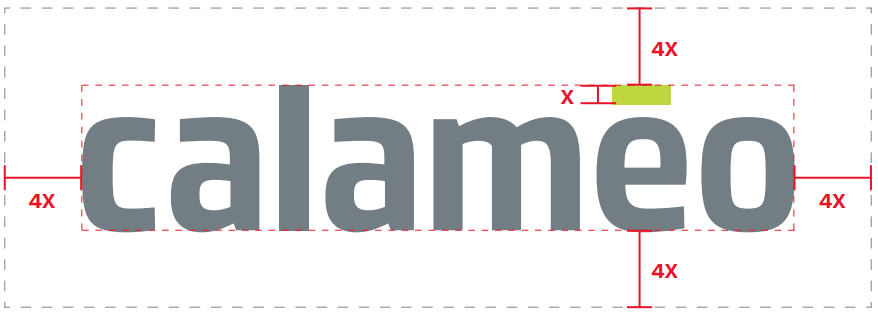
Take Calaméo’s logo, for example. The spacing and colors are exact: the dimensions around the lettering are determined by the height of the green accent, and the colors are specific to our brand.
There are other elements to consider. Do you have a slogan or motto with words as part of your logo? If so, you must clearly state where the slogan goes, how big it can be, the color(s) to use, and when to employ this version of the logo. There are many rules you must define in your brand style guide, especially when it comes to your logo.
Colors
Companies have specific brand colors, usually two to three, that they use in logos and branding. The style guide will include complementary colors as well. These colors all together are known as the company’s color palette.
Great thought and care go into a company’s color palette. There are even psychological tricks behind choosing certain colors that the company wants associated with the brand or product. They may want to demonstrate trust, youth, sophistication, or other descriptors.
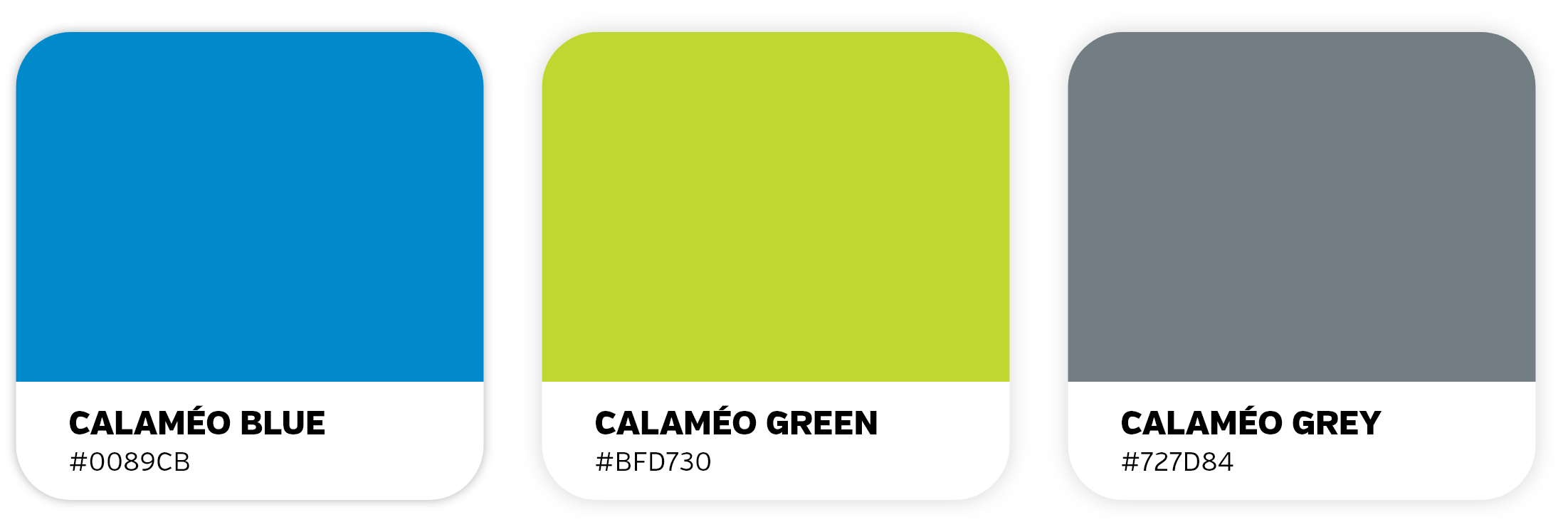
The brand style guide should outline all the ways to find these colors: a visual representation of the color, HEX and RGB formats, and other formats if necessary. Rather than just “blue” or “red”, companies choose very specific shades of these colors that go well together and set them apart from other brands. These exact shades need to be used every time.
Examples of Calaméo’s color palette using the HEX values
Typeface
Another important element of the brand style guide is typeface. Typeface is the kind of lettering used in communications, which includes fonts. Does your company use only lowercase letters? All capitals? You must include the size, spacing, and color of your typeface in your style guide so employees know exactly how the typeface should look.
Work with a graphic designer to choose the best typeface for your company. Some brands even create their own fonts! Keep in mind that your typeface also reflects your tone– is it silly, serious, elevated? Your typeface must work well with the other elements of your style guide.
Images
Some brand style guidelines include rules about styles of images or photographs to use. These images must fit into the brand’s identity and remain consistent; you should not use a bright and airy photograph one day and then a dark and moody photograph the next. The rules could include using colors from the company’s color palette or desired emotions that the images should evoke (energetic, powerful, soothing). Images are available to download on sites like Getty Images, Shutterstock, or Unsplash, if your company does not have access to a photographer or photography studio to create your own images. However, make sure to check that you have the right to use the images.
Icons
Brand style guides may also include illustrations or icons. Consider the icons you see on a company’s website: a shopping cart to click on when you are ready to purchase or an envelope icon if you want to communicate with the company via email. These icons must be coherent across all platforms. Icons will, much like the rest of the elements of the style guide, reflect the brand identity. Whimsical, rigid, colorful, playful…your icons can express a lot about your brand!
A few of Calaméo’s icons
Tone
Your tone and voice give your brand a personality via the written word. Once you decide who you are, it should be easy to find your company’s tone The brand style guide may include different instructions depending on the channel– perhaps your social media tone will be slightly less formal than that of your advertisements, for example. The guide should include written examples so employees can see how to employ the tone in different situations. Think of the image you want to project, and stay consistent.
Applying your style guide to digital publications
So now that you know all about style guides, it’s time to apply this knowledge to your digital publications! Because digital publishing is a visual medium, consistent brand visuals make all the difference between an amateur-looking document and a professional-grade publication.
With Calaméo, you can personalize your viewer Theme, add your logo, and enrich your content yourself so that your digital publications match your brand identity. With our White Label feature for PLATINUM members, your publications appear in your name and image, without the Calaméo logo. Start your free trial today!

 Try Calaméo PLATINUM free for 14 days and explore all our advanced features.