Making a strong connection between your audience and your brand is a key goal for digital publishers everywhere. In this article, get our tips on how to keep your audience engaged with your publications and improve reading time.
What is reading time?
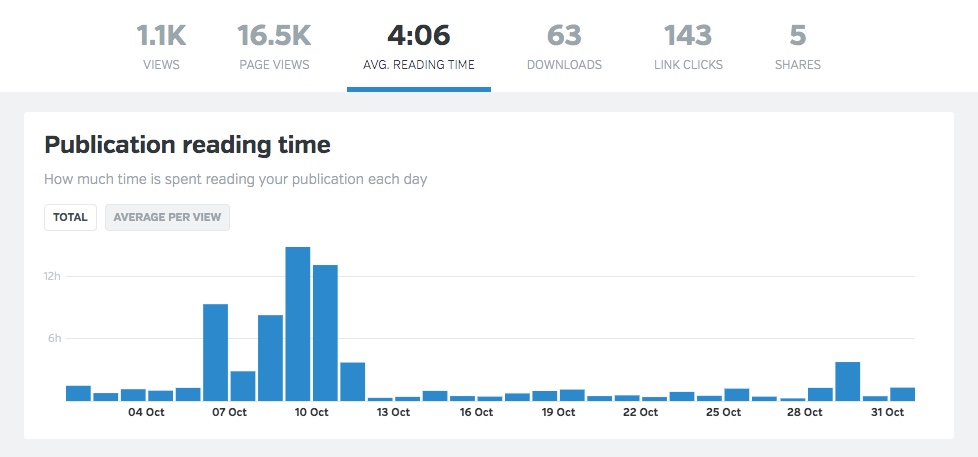
Reading time is a metric that shows how long people spend viewing your content. On Calaméo, this information is available as part of your account statistics.
You can toggle between the total reading time of your publications and the average reading time per view. The total reading time represents the combined amount across all views. The average reading time represents how long a typical view of your publication lasts.

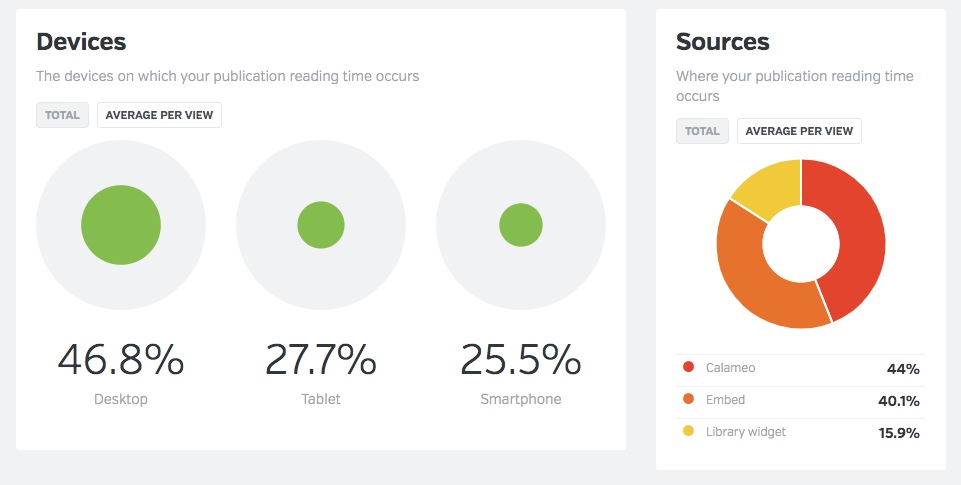
Thanks to your Calaméo statistics, it’s easy to explore daily, monthly and yearly trends in reading time. Plus, see mobile and desktop breakdown, sources and more.
Reading time can be an especially valuable way to measure audience engagement with your digital publications. The more time people spend reading, the more interested they are in your content—and the more likely they are to keep coming back.
With no further ado, here are four tips to improve reading time for your ditgital publications!
How can I improve reading time?
Use Bold Graphics
Grab your readers’ attention with lively layouts, like in this example from Mixte magazine:
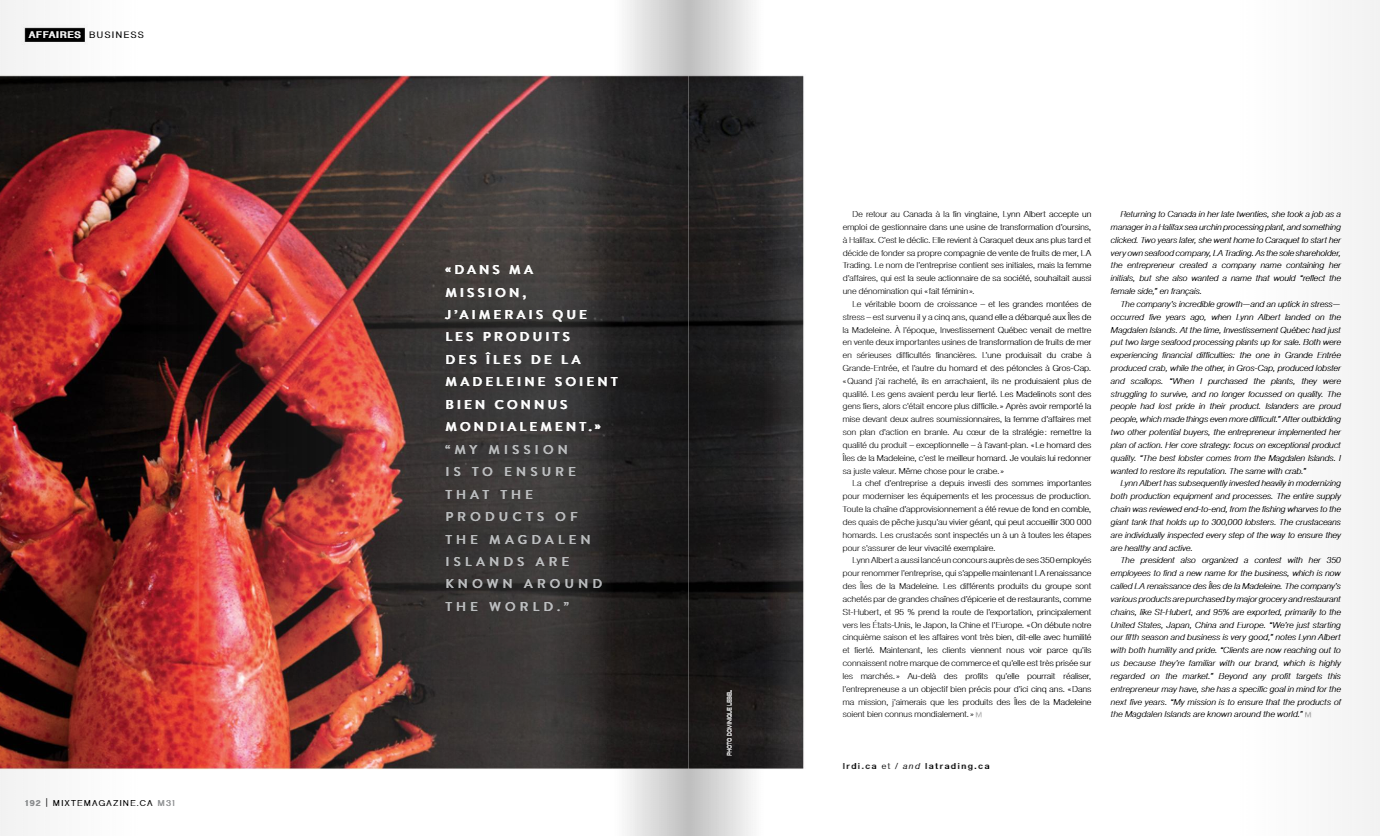
This large, colorful image paired with a pull quote invites the reader to dig into the article and find out more. Clean fonts and plenty of white space make the text easy to read. Fun fonts, new colors and infographics are other great ideas to try.
Index Key Terms
Some readers will view your publication to look for specific information. You can help them find it painlessly by optimizing your document for internal search. All of the text in your publication is automatically indexed for the search function inside our viewer. To benefit, make sure that essential terms are included as text rather than images.
💡TIP: Creating a table of contents for your publication can also make it easier to navigate. Then readers can spend less time in search frustration and more time enjoying your content!
Check External Links
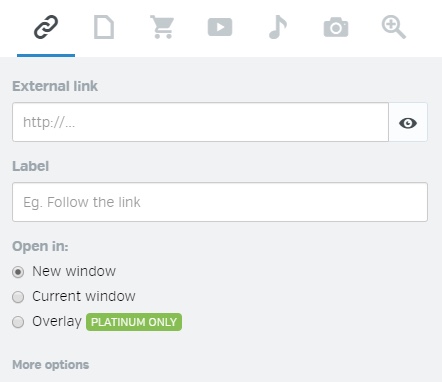
Publishing digitally allows your readers to shop products, visit advertisers and learn more about your business, all from their browser. Although it’s simple to add external links to your publications with the Calaméo Editor, don’t forget to check the “Open in a new window” box. That way, the publication won’t close when readers click your links and they can return to your content effortlessly. Seamless browsing is good UX and is a quick fix to improve reading time for your publications!
Get Interactive
Since video and audio have proven to be enormously engaging to today’s internet users, you can use them to good effect in your online publications. For example, in this catalog from Samedia, a video clip provides a product illustration:
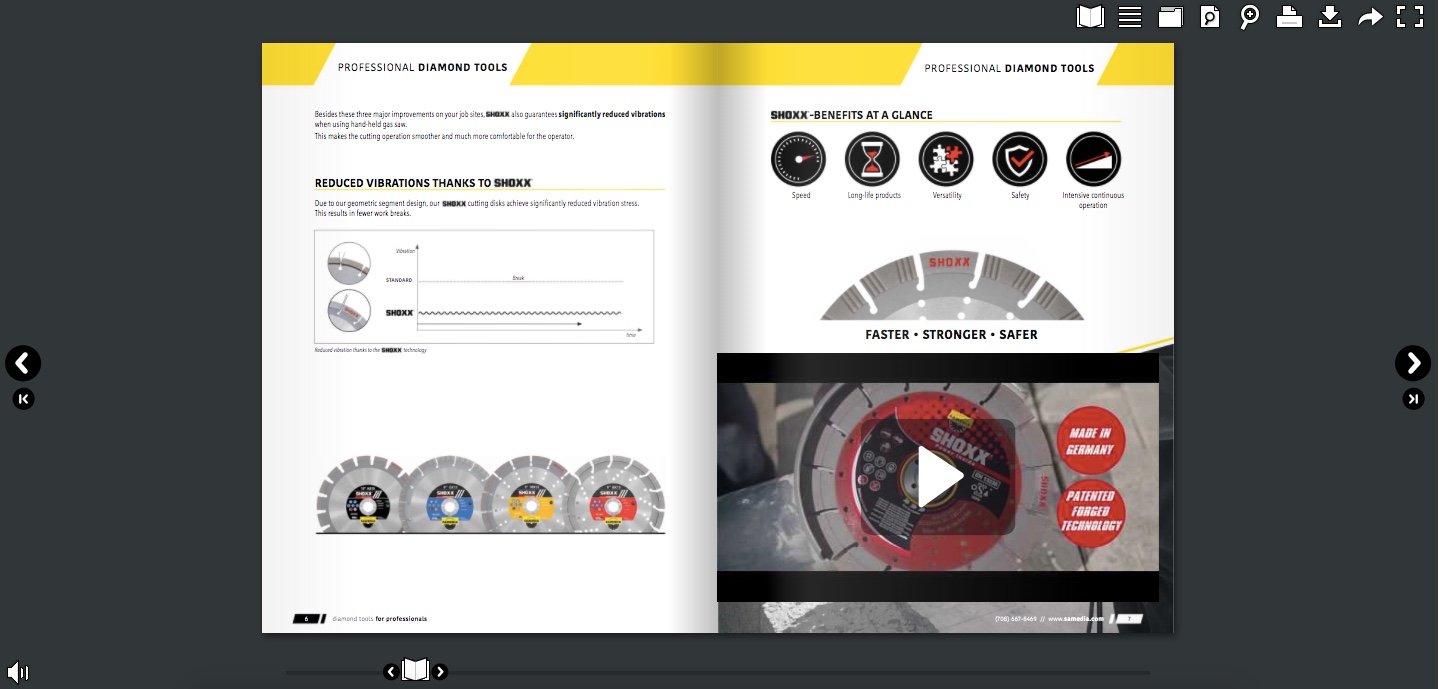
These interactive elements encourage your audience to watch, listen and dive deeper into your content. Result: higher reading times!
💡TIP: Calaméo’s PLATINUM plan lets you include audio from SoundCloud and video from YouTube directly on the page.
Equipped with our tips, you’re ready to improve reading time for your publications. But to go even further, evaluate which of your content performs best and adapt to your audience’s interests. Your advanced statistics includes pages with the longest reading times so you can identify areas to focus on—and keep growing audience engagement!
If you’re ready to give these tips a try, it’s time to request your PLATINUM Demo. During your two-week free trial, access the full range of unlimited statistics on Calaméo and test out the great features of our professional publishing plan.

Why publish an online magazine (instead of emailing a PDF)
Publishing an online magazine from a PDF isn’t just about “uploading a file” and sharing a link. If your goal is to grow an audience, boost visibility, and drive measurable actions (subscriptions, clicks, inquiries, sales), you need to treat your magazine like a real content asset.
A high-performing online magazine usually comes down to four pillars:
A clean embed on your website (to capture traffic, reinforce your brand, and improve SEO)
A multichannel distribution plan (website, email, social)
A solid mobile experience
Consistent analytics (UTMs + KPIs) so you can see what works and improve issue after issue
Publishing an online magazine means making editorial content accessible on any screen, easy to share, and measurable. The goal isn’t just display—it’s distribution (email/social/website), visibility (SEO), and analysis (engagement, sources, clicks).
Quick pre-publish checklist
Prep a landing page (SEO + context)
Plan distribution (website, email, social)
Add CTAs / links (subscribe, contact, offer)
Track (UTMs, KPIs, reporting)
Improve using the data (most-read sections)
Why choose Calaméo to publish an online magazine (from a PDF)
If you want to publish an online magazine that’s easy to read on mobile, easy to share, embeddable on your website, and measurable, Calaméo is a strong option. The goal isn’t just “put the PDF online”—it’s building a complete setup: reading experience + distribution + SEO + analytics.
Fast publishing, no technical headache
Calaméo lets you turn a PDF into a digital publication in just a few steps, without needing custom development. For a marketing or editorial team, that matters: you can publish new issues quickly, iterate, and keep a consistent release rhythm.
Publish directly from a PDF
A reading experience designed for the web
Easy updates and issue management for your team
A better reading experience (especially on mobile)
Most reading happens on smartphones now. Calaméo gives you a web-friendly experience compared to sending a PDF attachment: smoother navigation, better comfort, improved accessibility, and less friction.
Mobile-first reading (depending on your publication setup)
More intuitive navigation than a raw PDF (TOC/markers, depending on how you set it up)
To maximize SEO and keep control of your traffic, the best approach is to embed your magazine on your own domain—on an optimized “Issue” page. Calaméo supports that: you can share via link and/or embed the publication on a WordPress page, a landing page, or a “Magazine” hub page.
Website embedding (dedicated page) to reinforce your brand
A hub approach: issue page + archives + topic collections
Better alignment with your content strategy (SEO + conversion)
Distribution and privacy options that fit professional use cases
A magazine can be public (to acquire traffic) or restricted (subscribers, clients, internal). Depending on your needs, Calaméo lets you adjust how you share: open publication, link-based sharing, or more restricted access (based on your plan and settings).
Public distribution to grow reach
Controlled sharing when content is restricted
Alignment between goals (audience) and constraints (privacy)
Data-driven improvement, issue after issue
Publishing is just step one. What makes the difference is continuous optimization. With Calaméo, you can analyze publication performance and connect your distribution actions to measurable outcomes.
Performance tracking (views, engagement, clicks—depending on your plan)
Ability to structure tracking with UTMs (email, social, QR, partners)
Editorial optimization: see what truly grabs attention and what drives clicks
Built to drive actions (not just reading)
An online magazine can support business goals: subscriptions, contact requests, quote requests, traffic to key pages. Calaméo fits well here because it helps create a reading experience that pushes users toward useful next steps (landing pages, forms, product pages, etc.).
Links and CTAs placed where they matter (not only at the end)
Shorter path from reading to action (less friction)
Click measurement to improve CTR and conversion
Calaméo is a great fit if… – You publish issues regularly (magazine, journal, long-form newsletter) – You want to centralize distribution on a dedicated page (SEO + measurement) – You need something easy for a marketing/editorial team to run – You want to measure and optimize (sources, clicks, engagement) – You want a higher-quality experience than a PDF email attachment
How to plug it into your workflow (simple recommendation)
To get the most out of Calaméo with WordPress, a proven approach is:
Create an “Issue” page on your website (summary + table of contents + CTA)
Add the Calaméo publication (embed or a “Read” button)
Drive all channels to that page (email, social, QR)
Tag links with UTMs and track your KPIs
Reuse the same template for every issue (make it repeatable)
Step 1 — Prep your PDF for online reading
Check readability (and avoid “fake problems”)
A PDF can look perfect in print and still be hard to read on mobile. Before publishing, check:
font size (comfortable on screen)
contrast (text too light, busy backgrounds)
margins (content too close to edges)
consistency in headings and sections (mental navigation)
Reduce PDF weight without killing quality
File weight directly impacts the experience: heavier files load slower, and slow loads increase drop-off. Aim for a reasonable balance:
An online magazine isn’t just “for reading”—it should guide people. Plan for:
a clickable table of contents (if possible)
stable sections (so you can compare performance over time)
action zones: subscribe, explore an offer, contact, download
Step 2 — Choose the format: flipbook, scrolling, or hybrid
There’s no one “best format.” It depends on your audience and your goal.
Flipbook: magazine feel and navigation
A flipbook makes sense if you want to:
keep the page-flip experience
showcase layout and design
offer a print-like navigation feel
Scrolling: efficient, faster reading
A scrolling format (web-page style) works well if:
your content reads like an article
you want a more mobile-first experience
you want more indexable text around the content
Hybrid approach (often the most effective)
In practice, a strong strategy is to:
publish the magazine (flipbook/reader)
host it on a dedicated page with contextual text (summary, TOC, highlights, links)
turn key sections into SEO articles (excerpts) that link back to the full issue
Step 3 — Build one landing page per issue (the core of SEO)
A common mistake is sharing a magazine via a simple link without building a page on your own domain. The result: weak SEO visibility, less control over the reader journey, and fragmented measurement.
Recommended structure for an “Issue” page
Your page should stand on its own as real content. A simple, effective structure:
1) Clear title + promise
Example: “Magazine X — January 2026 Issue: trend A, feature B, interview C.”
2) Summary (5–8 lines)
Explain what readers will get, using the words your audience actually searches for (helps SEO and LLMs).
3) Table of contents (bullets work great)
Feature story: …
Interview: …
Picks/selection: …
Events/agenda: …
4) “Key takeaways” block (3–5 bullets)
Great for featured snippets and AI answers.
5) Primary CTA + secondary CTA
Primary: “Subscribe” / “Get the next issue” / “Explore the offer”
Secondary: “Download the print version” / “Contact the editorial team”
6) Embedded reader (or a “Read the magazine” button)
If you embed, leave enough space and make sure it’s responsive. If not, a clear “Read the magazine” button works well.
7) Links to archives and related content
Add:
“All issues”
“Topic collections”
“Related articles”
Simple, practical SEO wins
One dedicated page per issue (stable, descriptive URL)
What matters is consistency (same logic every issue).
Repeatable monthly reporting
top sources (+ trend)
top clicked links
best-performing sections/pages
2–3 recommendations for the next issue
Step 6 — Improve issue after issue (the optimization loop)
Your advantage compounds over time when you systematize:
repeat what performs (sections, angles, CTAs)
remove friction (mobile, speed, navigation)
build topic pages that recycle content (evergreen SEO)
turn top themes into long-form SEO articles (acquisition)
Common mistakes (and how to avoid them)
Publishing without a dedicated page
Without an issue page, you lose SEO, journey control, and conversion opportunities.
Sending the PDF as an email attachment
You lose tracking, update flexibility, and often the mobile experience.
Too many generic CTAs
Better: 1 primary CTA, 1 secondary, plus contextual CTAs in the right sections.
No UTM tracking
Without UTMs, you can’t reliably compare email vs social vs QR vs SEO.
Conclusion
A strong online magazine is a system: dedicated page + multichannel distribution + tracking + continuous improvement. Once that foundation is in place, every issue becomes a longer-lasting asset that shares better and drives measurable results.
CTA suggestion (edit as needed)
Button: “Publish your next issue”
Secondary button: “Set up clean tracking (UTM/GA4)”
FAQ
How do I publish a PDF as an online magazine with Calaméo?
Upload your PDF to Calaméo, publish it as an online magazine, then create an “Issue” page on your site (summary + TOC + CTA) that embeds the publication (or links to it). Add UTMs to your distribution links to measure what performs.
How do I embed a Calaméo magazine on WordPress?
Create (or open) your WordPress issue page, paste the Calaméo embed code/block, then check mobile rendering. Add text around it (summary, highlights, key topics) to improve the experience and strengthen SEO.
How do I get a Calaméo magazine to show up on Google?
Don’t rely on the embed alone. Publish each issue on a dedicated page with unique text (summary, topics, highlights), strong internal linking (“Magazine” hub, related articles), and solid mobile performance. That’s what helps Google understand and index the page.
Can I track Calaméo publication visits in GA4?
Yes. Use UTM-tagged links in emails, social posts, QR codes, and paid campaigns so GA4 can identify sources. Then combine that with publication stats to analyze engagement and outcomes.
What analytics can Calaméo track for a digital magazine?
In practice, you’ll want to track audience (views/readers), engagement (reading depth and time), and clicks (actions). With well-structured UTMs, you can connect performance to channels and campaigns (email, social, QR, ads). Calaméo can track things like:
Total views (overall volume)
Total downloads (strong intent signal)
Total pages viewed (reading depth)
Average reading time (retention/quality)
Total clicks (interaction on links)
Shares, favorites, comments (engagement/virality)
Device breakdown (desktop/mobile/tablet)
Reader location (geography)
Views by hour (timing insights)
And with GA4 properly set up, you can go further by:
Getting more realistic unique-user views
Analyzing the full journey (before/during/after reading)
Is it better to email a PDF attachment or share a Calaméo link?
Share a link. It’s easier on mobile, easier to update, and much easier to track. Attachments make measurement harder and often degrade the reading experience.
Flipbook or scrolling PDF: what works best for an online magazine?
Flipbooks preserve the “magazine” feel and highlight layout. Scrolling is more direct and often more mobile-first. The most effective setup is often hybrid: an SEO-optimized issue page plus the embedded (or linked) Calaméo publication.
To kick off the year, we’ve prepared a few ideas to help you with essential New Year’s resolutions for even better digital publications. These good habits will help your online publications reach the best of their potential all year long!
Polish your account page
Take five minutes to update the information in your Calaméo account page. By making sure that your account name, website and description are as accurate and relevant as possible, you can quickly and easily boost your business’s digital presence. (Remember to use your logo as an avatar, too!) Optimizing your account page will help you take advantage of our SEO and allow more readers to find your digital publications.
Publish regularly
In a digital world brimming with content, it’s important to establish consistency for your online publications. If your audience knows when to expect your publication, they are more likely to make a habit of enjoying it whether you bring out issues weekly, monthly or quarterly. Scheduling your publications in advance on Calaméo can be a powerful tool to manage deadlines and build a loyal readership.
Think big picture
The visual identity of your business is an important part of its online presence. Whether you link to your digital publications on Calaméo or embed them in your own site, you can customize the viewer to ensure a seamless fit between your documents and your brand. First, you can choose the best theme to display your publication or create your own to achieve that perfect look. Next, set a background image or add your company’s logo, as in the example below from Espace Publications. Strengthening the visual connection between your digital documents and your business can really help your publications shine!
Tell a story
Make good use of social media to get the biggest impact out of sharing your digital publications. Keep storytelling in mind on Facebook, LinkedIn and more! A post on any of these platforms can introduce your publication to the world, so be sure to communicate the part it plays in your business’s mission and why your audience should check it out. This tweet from the New York University Alumni Magazine is a great example:
The most recent issue of the NYU Alumni Magazine is here, and it's devoted to the stories of faculty, alumni, and students who are advancing social justice in creative, transformative ways: https://t.co/e46vNrPRvX
— New York University (@nyuniversity) May 11, 2021
Dig into your statistics
Calaméo’s readership statistics provide you with key information about your audience and the success of your online publications. For a refresher, check out our tips for updating your approach to analytics and make a habit out of tracking your statistics on Calaméo in 2022.
With these New Year’s digital publishing resolutions, you’ll be in great shape to start a stellar year.
Have you made your own resolutions this year for your digital publications? Let us know on Twitter @calameo! Don’t forget to follow us on Facebook, LinkedIn, Instagram and YouTube for all the latest Calaméo news and updates.