In the publishing industry, it’s essential to stand out from the crowd and capture readers’ attention. Calaméo, our digital publishing platform, offers innovative solutions to enrich your content and deliver an engaging, interactive reading experience. But did you know that by using some of the integrations we offer, you can take interactivity even further and optimize your publications? Here are five must-use integrations on Calaméo if you’re in the publishing business.

1) Embedly: offer an enriched reading experience
Our Embedly integration lets you enrich your publications by adding various interactive elements. Whether it’s videos, images, tweets or maps, Embedly offers you a multitude of possibilities to energize your content. Thanks to this integration, your publications become immersive, interactive experiences. Your readers can interact directly with the integrated elements, making their reading experience more engaging and memorable.
The integration of YouTube on Calaméo is a major boost for publishers wishing to enrich their publications with video content. Imagine being able to include author interviews, or even book trailers, directly in your documents. Not only does this capture readers’ attention, it also allows them to access additional information without leaving the page. Videos add a visual and dynamic dimension that can transform ordinary reading into a unique experience.
Understanding your readers’ opinions is essential to continually improving your publications. With our Typeform integration, you can easily integrate polls, questionnaires and interactive forms directly into your documents. This feature enables you to gather detailed and constructive feedback from your readers, while keeping them engaged. With Typeform, you can ask relevant questions, analyze responses and adjust your content according to your audience’s expectations and preferences.
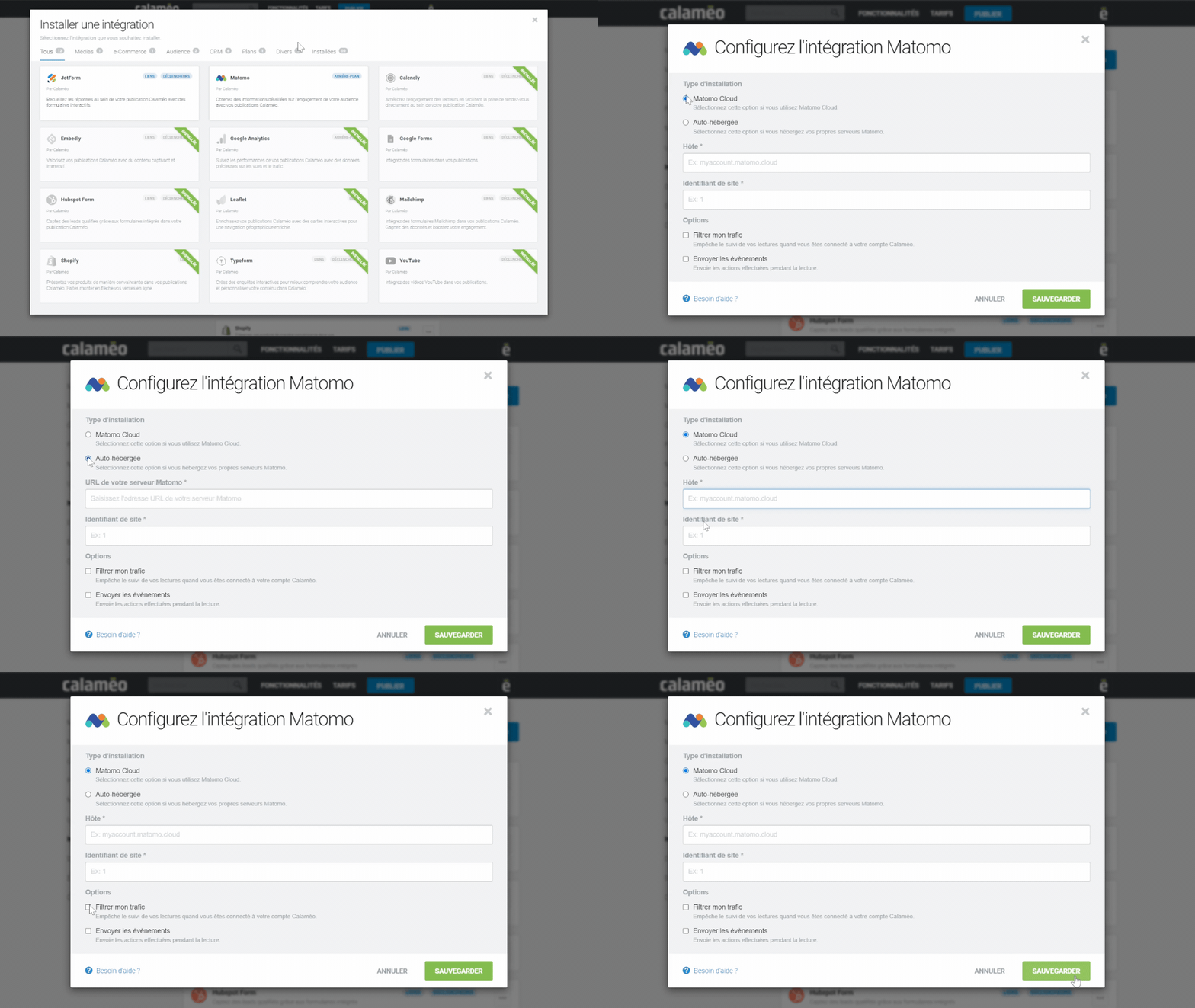
If you already use Matomo to collect statistics for your website, you can now also use it to track the performance of your Calaméo publications and better understand the behavior of your readers. This analysis tool provides you with precise, detailed data on the performance of your publications. You can track key metrics such as number of views, time spent on each page, click-through rates and much more. This information enables you to identify what’s working and what’s not, and adjust your strategies accordingly to maximize the impact of your content.
5) MailChimp: invite readers to subscribe to your newsletter
MailChimp‘s integration with Calaméo enables you to turn your readers into loyal subscribers. By integrating newsletter sign-up forms directly into your publications, you can easily collect the e-mail addresses of interested readers. This not only makes it easier to grow your subscriber list, but also to maintain a constant link with your audience by sending them regular updates and exclusive content. This integration simplifies the subscription process and increases your readers’ chances of loyalty.
As a professional in the publishing industry, using Calaméo and its integrations can radically transform the way you publish and share your content. Embedly,YouTube, Typeform, Matomo, andMailChimp are powerful tools that not only enrich your publications, but also enable you to better understand and interact with your readers. Adopt these integrations and offer your audience a unique, interactive reading experience that will keep them captivated and engaged.
What comes to mind when you hear the name Gutenberg? If you work on a website, you might think about the blogging platform WordPress and its Gutenberg content editor. If you’re a fan of e-books, you might think of the Project Gutenberg library of free titles. And if you’re a fan of the Police Academy movies, you might think of Steve Guttenberg.
But only one Gutenberg was the original tech mogul who disrupted the publishing industry. In 1439, this German inventor developed a kind of press that made it possible to print text in multiple copies. Of course, like many tech icons, Gutenberg was actually the second person to invent his device. Although it wasn’t widely adopted at the time, Bi Shengcreated moveable type 400 years earlier in China.
It may seem funny to talk about books like a technology, the same way we talk about smartphones and apps. Despite their low-tech material of paper and ink, books are technology: an object invented to store information. That’s why we’re taking a look at how innovation has shaped the history of publishing, from ancient eras right up to today.
Handmade books
Before Bi Sheng and Gutenberg’s printing inventions, every single book around the world was made by hand. These manuscripts, or hand-written texts, came in two main formats. Scrolls had writing on a single, rolled-up surface. On the other hand, a codex would look much more like a modern book. They had multiple pages inside a pair of wooden boards. But compared to printed books, very few manuscripts existed.
In large part, handmade books were rare because of the time, effort and resources required to create them. Not only did you need someone who knew how to write—not easy to find thousands of years ago—you’d also need something to write on and with. Some common materialsincluded clay and wax tablets, papyrus paper and parchment. Besides quill and ink, styluses and calames were also used to write. And once you gathered the materials and found a scribe, it could take years to copy out a text.
Because books and writing were advanced technologies most people never encountered in the handmade era, cultural information was stored in other ways. For example, the art and decoration on buildings like churches told visual stories to their viewers. Music, folktales and good old memorization were also important forms for sharing knowledge. However, the arrival of the printing press was about to revolutionize books.
Publishing revolutions
Printing wasn’t special to the printing press, but the concept of moveable type was. For centuries, artists knew to carve a flat image onto a block of wood, cover it with ink and press it against a paper page to make a print. Gutenberg and Bi Sheng’s innovation was to produce images of individual letters, or characters. Then, these letters were arranged into the text of a page and set into a frame for printing.
Although it might not sound like much, this moveable type technology meant that printing a page took minutes instead of weeks. Printing a book of 100 pages took weeks, not years. Plus, making copies was simple. As a result, more and more books entered circulation. Books held more information and, in Europe, more people read them throughout the Renaissance and Enlightenment. Publishers began to print and sell books on a bigger scale than ever.
One reason why the audience for books exploded? Education expanded dramatically in many places across the world. A growing number of people could read and they bought books. History, science, fiction, philosophy, dictionaries, travel guides—publishers offered books in every genre as printing technology advanced. Presses improved, paper became cheaper and by the end of the 20th century, the business of making and selling books had spread into a global industry worth billions of dollars.
Digital experiments
But the story of publishing innovation doesn’t end there. The invention of computers and the Internet created new tools for writing. From the clay tablets and calames to desktops and digital formats, another huge technological shift has been changing publishing over the past several decades. Unlike printing, however, digital publishing has taken lots of different directions as audiences try new experiences.
For example, publishing books on CD-ROM was a major trend in the 1990s. As old-fashioned as that sounds today, CD-ROM publishing let users access a large amount of information easily. In fact, an early digital encyclopedia set was priced 86% cheaper than the equivalent 21 volumes of printed books. And the format could include multimedia audio, video and links.
While CD-ROMs were replacing traditional encyclopedias, more experiments were happening online. Twitter launched in 2006 and by 2008, people were using it to write novels 140 characters at a time. The Kindle launched in 2007 and by 2010, e-books made up an important part of sales. New channels, formats and ideas are still developing and evolving online very quickly. After all, who needs a CD-ROM reference publication when you have Wikipedia?
To be continued
In short, the book is a technology that has been renewed to meet the needs of readers for hundreds and thousands of years. As publishers face digital challenges in the 21st century, there’s plenty of reasons to be optimistic about the future. Handmade, machine-printed or digital: books are always adapting so that more people can access them—and the knowledge inside.
Read this article in our 7th issue of Calaméo Magazine, as well as many others on the theme of renewal and innovation:
And if you haven’t read all the other issues of Calaméo Magazine yet, you can find them right here.
Why publish an online magazine (instead of emailing a PDF)
Publishing an online magazine from a PDF isn’t just about “uploading a file” and sharing a link. If your goal is to grow an audience, boost visibility, and drive measurable actions (subscriptions, clicks, inquiries, sales), you need to treat your magazine like a real content asset.
A high-performing online magazine usually comes down to four pillars:
A clean embed on your website (to capture traffic, reinforce your brand, and improve SEO)
A multichannel distribution plan (website, email, social)
A solid mobile experience
Consistent analytics (UTMs + KPIs) so you can see what works and improve issue after issue
Publishing an online magazine means making editorial content accessible on any screen, easy to share, and measurable. The goal isn’t just display—it’s distribution (email/social/website), visibility (SEO), and analysis (engagement, sources, clicks).
Quick pre-publish checklist
Prep a landing page (SEO + context)
Plan distribution (website, email, social)
Add CTAs / links (subscribe, contact, offer)
Track (UTMs, KPIs, reporting)
Improve using the data (most-read sections)
Why choose Calaméo to publish an online magazine (from a PDF)
If you want to publish an online magazine that’s easy to read on mobile, easy to share, embeddable on your website, and measurable, Calaméo is a strong option. The goal isn’t just “put the PDF online”—it’s building a complete setup: reading experience + distribution + SEO + analytics.
Fast publishing, no technical headache
Calaméo lets you turn a PDF into a digital publication in just a few steps, without needing custom development. For a marketing or editorial team, that matters: you can publish new issues quickly, iterate, and keep a consistent release rhythm.
Publish directly from a PDF
A reading experience designed for the web
Easy updates and issue management for your team
A better reading experience (especially on mobile)
Most reading happens on smartphones now. Calaméo gives you a web-friendly experience compared to sending a PDF attachment: smoother navigation, better comfort, improved accessibility, and less friction.
Mobile-first reading (depending on your publication setup)
More intuitive navigation than a raw PDF (TOC/markers, depending on how you set it up)
To maximize SEO and keep control of your traffic, the best approach is to embed your magazine on your own domain—on an optimized “Issue” page. Calaméo supports that: you can share via link and/or embed the publication on a WordPress page, a landing page, or a “Magazine” hub page.
Website embedding (dedicated page) to reinforce your brand
A hub approach: issue page + archives + topic collections
Better alignment with your content strategy (SEO + conversion)
Distribution and privacy options that fit professional use cases
A magazine can be public (to acquire traffic) or restricted (subscribers, clients, internal). Depending on your needs, Calaméo lets you adjust how you share: open publication, link-based sharing, or more restricted access (based on your plan and settings).
Public distribution to grow reach
Controlled sharing when content is restricted
Alignment between goals (audience) and constraints (privacy)
Data-driven improvement, issue after issue
Publishing is just step one. What makes the difference is continuous optimization. With Calaméo, you can analyze publication performance and connect your distribution actions to measurable outcomes.
Performance tracking (views, engagement, clicks—depending on your plan)
Ability to structure tracking with UTMs (email, social, QR, partners)
Editorial optimization: see what truly grabs attention and what drives clicks
Built to drive actions (not just reading)
An online magazine can support business goals: subscriptions, contact requests, quote requests, traffic to key pages. Calaméo fits well here because it helps create a reading experience that pushes users toward useful next steps (landing pages, forms, product pages, etc.).
Links and CTAs placed where they matter (not only at the end)
Shorter path from reading to action (less friction)
Click measurement to improve CTR and conversion
Calaméo is a great fit if… – You publish issues regularly (magazine, journal, long-form newsletter) – You want to centralize distribution on a dedicated page (SEO + measurement) – You need something easy for a marketing/editorial team to run – You want to measure and optimize (sources, clicks, engagement) – You want a higher-quality experience than a PDF email attachment
How to plug it into your workflow (simple recommendation)
To get the most out of Calaméo with WordPress, a proven approach is:
Create an “Issue” page on your website (summary + table of contents + CTA)
Add the Calaméo publication (embed or a “Read” button)
Drive all channels to that page (email, social, QR)
Tag links with UTMs and track your KPIs
Reuse the same template for every issue (make it repeatable)
Step 1 — Prep your PDF for online reading
Check readability (and avoid “fake problems”)
A PDF can look perfect in print and still be hard to read on mobile. Before publishing, check:
font size (comfortable on screen)
contrast (text too light, busy backgrounds)
margins (content too close to edges)
consistency in headings and sections (mental navigation)
Reduce PDF weight without killing quality
File weight directly impacts the experience: heavier files load slower, and slow loads increase drop-off. Aim for a reasonable balance:
An online magazine isn’t just “for reading”—it should guide people. Plan for:
a clickable table of contents (if possible)
stable sections (so you can compare performance over time)
action zones: subscribe, explore an offer, contact, download
Step 2 — Choose the format: flipbook, scrolling, or hybrid
There’s no one “best format.” It depends on your audience and your goal.
Flipbook: magazine feel and navigation
A flipbook makes sense if you want to:
keep the page-flip experience
showcase layout and design
offer a print-like navigation feel
Scrolling: efficient, faster reading
A scrolling format (web-page style) works well if:
your content reads like an article
you want a more mobile-first experience
you want more indexable text around the content
Hybrid approach (often the most effective)
In practice, a strong strategy is to:
publish the magazine (flipbook/reader)
host it on a dedicated page with contextual text (summary, TOC, highlights, links)
turn key sections into SEO articles (excerpts) that link back to the full issue
Step 3 — Build one landing page per issue (the core of SEO)
A common mistake is sharing a magazine via a simple link without building a page on your own domain. The result: weak SEO visibility, less control over the reader journey, and fragmented measurement.
Recommended structure for an “Issue” page
Your page should stand on its own as real content. A simple, effective structure:
1) Clear title + promise
Example: “Magazine X — January 2026 Issue: trend A, feature B, interview C.”
2) Summary (5–8 lines)
Explain what readers will get, using the words your audience actually searches for (helps SEO and LLMs).
3) Table of contents (bullets work great)
Feature story: …
Interview: …
Picks/selection: …
Events/agenda: …
4) “Key takeaways” block (3–5 bullets)
Great for featured snippets and AI answers.
5) Primary CTA + secondary CTA
Primary: “Subscribe” / “Get the next issue” / “Explore the offer”
Secondary: “Download the print version” / “Contact the editorial team”
6) Embedded reader (or a “Read the magazine” button)
If you embed, leave enough space and make sure it’s responsive. If not, a clear “Read the magazine” button works well.
7) Links to archives and related content
Add:
“All issues”
“Topic collections”
“Related articles”
Simple, practical SEO wins
One dedicated page per issue (stable, descriptive URL)
What matters is consistency (same logic every issue).
Repeatable monthly reporting
top sources (+ trend)
top clicked links
best-performing sections/pages
2–3 recommendations for the next issue
Step 6 — Improve issue after issue (the optimization loop)
Your advantage compounds over time when you systematize:
repeat what performs (sections, angles, CTAs)
remove friction (mobile, speed, navigation)
build topic pages that recycle content (evergreen SEO)
turn top themes into long-form SEO articles (acquisition)
Common mistakes (and how to avoid them)
Publishing without a dedicated page
Without an issue page, you lose SEO, journey control, and conversion opportunities.
Sending the PDF as an email attachment
You lose tracking, update flexibility, and often the mobile experience.
Too many generic CTAs
Better: 1 primary CTA, 1 secondary, plus contextual CTAs in the right sections.
No UTM tracking
Without UTMs, you can’t reliably compare email vs social vs QR vs SEO.
Conclusion
A strong online magazine is a system: dedicated page + multichannel distribution + tracking + continuous improvement. Once that foundation is in place, every issue becomes a longer-lasting asset that shares better and drives measurable results.
CTA suggestion (edit as needed)
Button: “Publish your next issue”
Secondary button: “Set up clean tracking (UTM/GA4)”
FAQ
How do I publish a PDF as an online magazine with Calaméo?
Upload your PDF to Calaméo, publish it as an online magazine, then create an “Issue” page on your site (summary + TOC + CTA) that embeds the publication (or links to it). Add UTMs to your distribution links to measure what performs.
How do I embed a Calaméo magazine on WordPress?
Create (or open) your WordPress issue page, paste the Calaméo embed code/block, then check mobile rendering. Add text around it (summary, highlights, key topics) to improve the experience and strengthen SEO.
How do I get a Calaméo magazine to show up on Google?
Don’t rely on the embed alone. Publish each issue on a dedicated page with unique text (summary, topics, highlights), strong internal linking (“Magazine” hub, related articles), and solid mobile performance. That’s what helps Google understand and index the page.
Can I track Calaméo publication visits in GA4?
Yes. Use UTM-tagged links in emails, social posts, QR codes, and paid campaigns so GA4 can identify sources. Then combine that with publication stats to analyze engagement and outcomes.
What analytics can Calaméo track for a digital magazine?
In practice, you’ll want to track audience (views/readers), engagement (reading depth and time), and clicks (actions). With well-structured UTMs, you can connect performance to channels and campaigns (email, social, QR, ads). Calaméo can track things like:
Total views (overall volume)
Total downloads (strong intent signal)
Total pages viewed (reading depth)
Average reading time (retention/quality)
Total clicks (interaction on links)
Shares, favorites, comments (engagement/virality)
Device breakdown (desktop/mobile/tablet)
Reader location (geography)
Views by hour (timing insights)
And with GA4 properly set up, you can go further by:
Getting more realistic unique-user views
Analyzing the full journey (before/during/after reading)
Is it better to email a PDF attachment or share a Calaméo link?
Share a link. It’s easier on mobile, easier to update, and much easier to track. Attachments make measurement harder and often degrade the reading experience.
Flipbook or scrolling PDF: what works best for an online magazine?
Flipbooks preserve the “magazine” feel and highlight layout. Scrolling is more direct and often more mobile-first. The most effective setup is often hybrid: an SEO-optimized issue page plus the embedded (or linked) Calaméo publication.