Thanks to digital marketing, getting the word out about your business has never been easier. However, it often takes time for a potential customer to go from visiting your website to buying your product. A strategy to generate leads can help make sure that you identify interested users. Then, follow up and make the sale!
In this article, we will reveal simple ways to put your digital publications to work as lead generation tools.
The pop-up contact form is a classic method to generate leads online that we have mentioned before here on the blog.
While pop-up forms are a great choice, especially if you are producing exclusive content, they can be time-consuming to manage. Consider an even more streamlined, user-friendly approach: a smart Contact button.
Why does a Contact button help generate leads?
No matter what kind of content you are publishing digitally, you’ll want readers to be able to contact you as easily as possible. Our Editor lets you add links inside your publication for users to email or call your business.
Creating a Contact button makes an easy path from browsing your content to getting in touch. As a result, users benefit and you capture high-quality leads. In fact, this simple tool saves readers from having to:
return to your site
hunt for contact info
open their inbox
enter your email address
That’s a lot of work just to ask a question! Instead, potential customers are free to check out your publication, click your contact link and call or email you instantly.
How to add a Contact button to your publications
Once you have decided where your contact links will appear in your publication, all you need to do is open it with the Calaméo Editor.
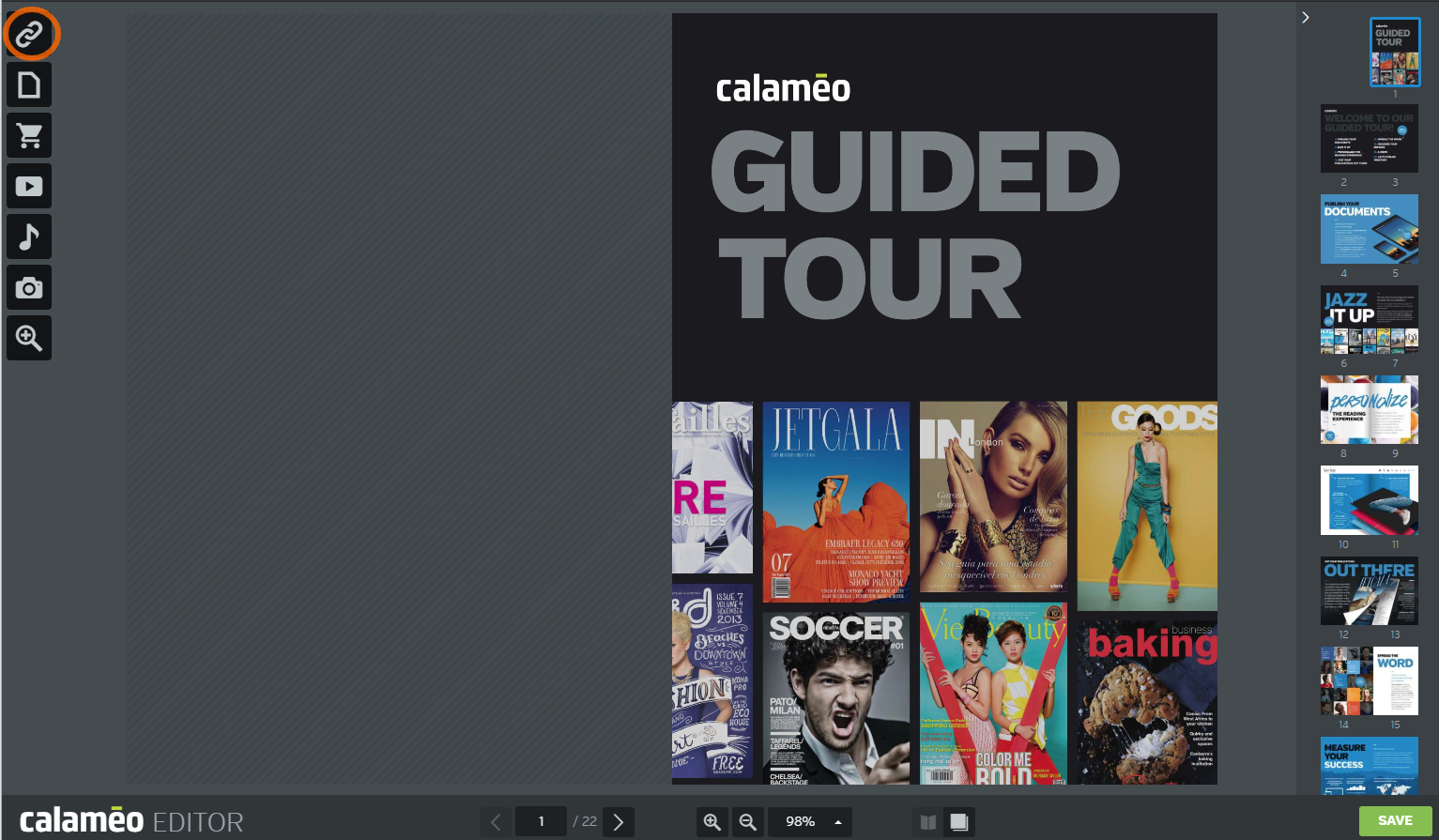
Next, select the External Link icon and draw a link in the place you’ve picked for a contact link.
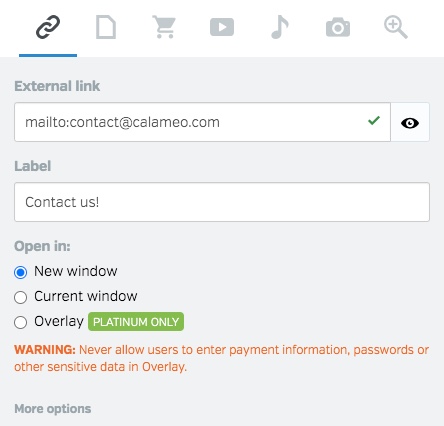
To create an email message from your contact link, enter “mailto:” followed by your business’s email address in the External link field. If a reader clicks this link, her computer’s email client will open a new message to the chosen address.
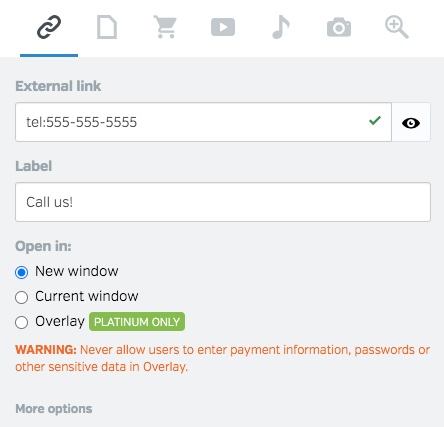
To add a telephone link, enter “tel:” followed by your business’s phone number in the External link field. Your readers can place a call directly from your publication just by clicking the link!
💡 TIP: Note that telephone contact links are only authorized for devices with native telephone capabilities, such as tablets and smartphones. Email contact links work on any device.
How to add a Contact button to the viewer
By investing a little extra time, you can also make use of contact links in our publication viewer to generate leads. We recommend creating a custom Skin to include a Contact button. Here’s an example in the toolbar of our Default:
You can learn more about how to design your own Skin on our Developers page or in our illustrated, step-by-step tutorial. Plus, making changes is easier than ever with our Elements feature, which lets you edit your publication’s viewer Skin right in your Calaméo account.
Whether you prefer a Contact button on the page or in the viewer, it’s a must-have for generating leads from your online content. And with Calaméo, you never have to sacrifice the immersive experience offered by digital publications for seamless customer contact.
In short, contact links are one more way that interactive digital publishing on Calaméo helps your business go beyond the PDF!
To try out these ideas to generate leads with digital publishing, request your 14-day PLATINUM Demo. You’ll enjoy access to all the great features of our professional plan, no credit card required.
What better way to start the year than by setting resolutions? For 2023, you’ll be required to include updating your content marketing strategy, and you’ll need to put in the work to make sure it’s flawless and eclipses those of your competitors.
Videos, articles, photos and online magazines will need to be more impactful than ever! And to support you in your resolution, today we’re sharing the top content trends for 2023.
1. Short videos
The video format has a promising future. Notably, because it can easily adapt to changing fashions and shape itself according to needs. In 2023, it is the short videos that will be honored. Made popular in turn by Vine in 2013, then by Tik Tok in 2020, the format of short videos continues to conquer social networking platforms in recent years, such as Instagram and its “Reels”.
YouTube has also introduced a new specific format of short videos on its platform, named “Shorts”. In 2021, more than 1.5 billion monthly users watched Shorts. It’s not a surprise that YouTube has decided to monetize Shorts. Indeed, these are very engaging contents with a strong viral potential, they can reach thousands or even millions of views much more easily than traditional length videos thanks to their faster pace and more engaging vertical format, which keeps the audience’s attention from the beginning to the end.
So short videos are a must-have format this year to add to your content marketing strategy.
2. Podcasts
The podcast has become a must-have format for content creators and brands alike. Not only is it an easy format for the public to consume, to listen to on the go, or while cooking, for example. But it also allows you to position yourself as an expert in your field and attract new prospects.
In France, 1 out of 2 people have already listened to a podcast, which shows how important the format has become in recent years. It is therefore essential for you to create your own podcast in 2023.
Choose your formula according to your resources: with or without guest, on which platforms to host it, etc. Then go for it!
3. Behind-the-scenes photos
In 2023, on social media, the people expects to see more authenticity. Gone are the filters and retouching, the trend is towards “reality”. To reach the new generation of young adults, generation Z, you must now necessarily play the natural card. The trend has even allowed the birth and growth of the new social network BeReal, which offers to share photos to its network instantly, without being able to retouch them.
For companies, a good idea to meet this new expectation will be to offer more ” behind-the-scenes ” content, which reveals what goes on behind your brand and presents the faces that make it work day by day. This will make your customers feel closer to you and improve your brand image, in just a few posts.
So, don’t hesitate to share your company’s daily life on social networks in 2023.
4. Content that show your values
If the year 2020 was marked by the COVID virus, it was also marked by major social movements like Black Lives Matter. During the summer of 2020, we saw many brands and public figures get involved by sharing statistics or information with their audiences in support of the movement.
Thus, brands are now expected to get involved in social movements: gender equality, racism, environment, social inequalities, etc. In France in 2022, 89% of people expect brands to do something for the common good.
This demand for brand involvement can also be explained by the trend described in the previous point: an expectation of more naturalness, and more transparency from brands, but also, ultimately, of more humanity.
If generation Z is the most sensitive to environmental issues, it demands a real commitment from brands. Thus, it will no longer be possible to display a false commitment and to do Greenwashing because it will necessarily lead to bad buzz, or even boycott by an entire generation.
In 2023, creating socially-engaged content that reflects your brand’s true actions and beliefs is essential to attract new consumers to your products.
5. Sustainable content
It has always been advisable to create high-value content, however, in 2023, the bulk of your content will have to provide interesting, timeless and highly useful information to your audience to be considered green and sustainable.
Indeed, it is in response to environmental concerns that this trend was born. We will therefore prefer quality to quantity. Your contents must be original and offer original and imperishable information to be qualified as sustainable.
If the lifespan of content is often very low on social networks, you will have to think about the use you make of your various channels. To increase the lifespan of your content, it is advisable to use sites such as Pinterest, YouTube or digital publishing platforms such as Calaméo. Offer formats like videos, infographics or online magazines to ensure you offer quality content that lasts over time.
Authenticity will be the keyword for your content in 2023. Less perfect publications, less retouched, but more real and more useful. Show the true face of your brand (and your employees) by supporting the causes you care about and create a podcast on the subject, or film short videos of your actions. In conclusion, rework your content marketing strategy to reflect the expectations of new consumers and to remain effective in 2023.
Have you ever seen an advertisement and immediately known which company it belonged to, even if you didn’t glimpse the name? Chances are you recognized certain facets of that company: special fonts, taglines, logos, and color combinations that belong unmistakably to a brand. These elements, and more, make up a brand’s identity. All visual and editorial aspects of a brand’s identity are determined by the brand’s style guide.
On the Calaméo blog we have talked about logos, brand identity and brand image. Next up? Brand style guides, sometimes called graphic charters or brand guidelines. In this article we will discuss the ins and outs of this important document, so let’s dive in!
First thing’s first: what is a brand style guide? A brand style guide is a document that governs all the visual (and sometimes editorial) elements of a company that make it recognizable and unique. It also explains when and how to use these elements. Simply put, a style guide is the key to all communications!
These guides ensure that there is no confusion when it comes to what the brand’s content should look and sound like. Using the guide as a reference, all company communications are consistent across channels and mediums. The style guide can be as detailed as you like; typically, larger companies have more comprehensive style guides because they are more likely to use a wider range of communication channels, and they appear in more places (television, print, online, etc.).
Who creates the style guide?
The creation of brand style guides is best left to professionals. However, it’s a collaborative process: graphic designers or design firms will work with you to create a style guide that suits your company and fits your brand identity. You must decide who you are, your values, and the image you’d like to portray to the world.
Why and how should you use a style guide?
A brand style guide is essential for your company’s brand identity. In order to maintain clear and cohesive communications across all channels, a style guide is the ultimate reference. Internal documents such as slide decks and employee newsletters, external communications such as advertisements or social media posts, plus everything in between: all of this content must look similar and adhere to your brand identity. To achieve this consistency, companies must have a brand style guide. Otherwise, logos may appear in the wrong colors and dimensions, there won’t be a uniform look to your communications, and your tone will be all over the place. Any communication that comes from the company, both internally and externally, should use the style guide as a reference.
What is included in a style guide?
Length and details may vary depending on the company, but a brand style guide is usually made up of the following visual and editorial elements:
Logo
Logos are a crucial part of a brand’s identity, its most visible identifier. Logos are images, texts, or shapes (or a combination of the three) in the company’s color palette that represent the company. A blue bird invokes Twitter, three stripes on a sneaker will certainly mean that they are Adidas, and a swoosh (both the shape and the word) is emblematic of Nike.
A company’s logo cannot be used haphazardly. The brand style guide should explicitly outline the exact colors and dimensions of the logo. Even the background on which the logo appears is specified in the style guide.
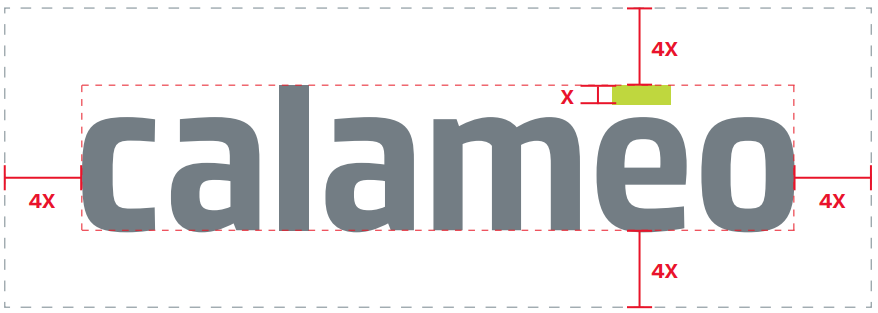
Take Calaméo’s logo, for example. The spacing and colors are exact: the dimensions around the lettering are determined by the height of the green accent, and the colors are specific to our brand.
There are other elements to consider. Do you have a slogan or motto with words as part of your logo? If so, you must clearly state where the slogan goes, how big it can be, the color(s) to use, and when to employ this version of the logo. There are many rules you must define in your brand style guide, especially when it comes to your logo.
Colors
Companies have specific brand colors, usually two to three, that they use in logos and branding. The style guide will include complementary colors as well. These colors all together are known as the company’s color palette.
Great thought and care go into a company’s color palette. There are even psychological tricks behind choosing certain colors that the company wants associated with the brand or product. They may want to demonstrate trust, youth, sophistication, or other descriptors.
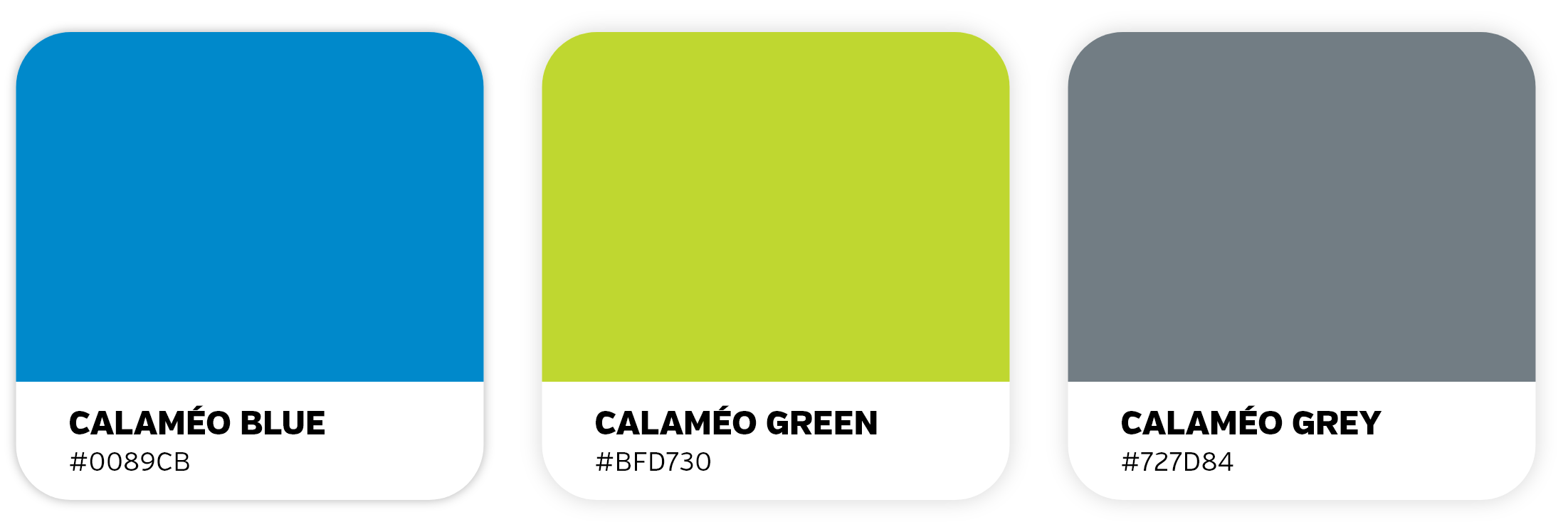
The brand style guide should outline all the ways to find these colors: a visual representation of the color, HEX and RGB formats, and other formats if necessary. Rather than just “blue” or “red”, companies choose very specific shades of these colors that go well together and set them apart from other brands. These exact shades need to be used every time.
Examples of Calaméo’s color palette using the HEX values
Typeface
Another important element of the brand style guide is typeface. Typeface is the kind of lettering used in communications, which includes fonts. Does your company use only lowercase letters? All capitals? You must include the size, spacing, and color of your typeface in your style guide so employees know exactly how the typeface should look.
Work with a graphic designer to choose the best typeface for your company. Some brands even create their own fonts! Keep in mind that your typeface also reflects your tone– is it silly, serious, elevated? Your typeface must work well with the other elements of your style guide.
Images
Some brand style guidelines include rules about styles of images or photographs to use. These images must fit into the brand’s identity and remain consistent; you should not use a bright and airy photograph one day and then a dark and moody photograph the next. The rules could include using colors from the company’s color palette or desired emotions that the images should evoke (energetic, powerful, soothing). Images are available to download on sites like Getty Images, Shutterstock, or Unsplash, if your company does not have access to a photographer or photography studio to create your own images. However, make sure to check that you have the right to use the images.
Icons
Brand style guides may also include illustrations or icons. Consider the icons you see on a company’s website: a shopping cart to click on when you are ready to purchase or an envelope icon if you want to communicate with the company via email. These icons must be coherent across all platforms. Icons will, much like the rest of the elements of the style guide, reflect the brand identity. Whimsical, rigid, colorful, playful…your icons can express a lot about your brand!
A few of Calaméo’s icons
Tone
Your tone and voice give your brand a personality via the written word. Once you decide who you are, it should be easy to find your company’s tone The brand style guide may include different instructions depending on the channel– perhaps your social media tone will be slightly less formal than that of your advertisements, for example. The guide should include written examples so employees can see how to employ the tone in different situations. Think of the image you want to project, and stay consistent.
Applying your style guide to digital publications
So now that you know all about style guides, it’s time to apply this knowledge to your digital publications! Because digital publishing is a visual medium, consistent brand visuals make all the difference between an amateur-looking document and a professional-grade publication.
With Calaméo, you can personalize your viewer Theme, add your logo, and enrich your content yourself so that your digital publications match your brand identity. With our White Label feature for PLATINUM members, your publications appear in your name and image, without the Calaméo logo. Start your free trial today!